Balanced Dog Training 

Real World Results 

Step 1.

Schedule your free evaluation


We will discuss your goals for training, our training philosophy, your dog’s behavior, pricing, and any questions you may have.


We encourage you to upload videos of you performing some basic obedience with your dog and footage of any concerning behavior as long as it is safe to get video of.

Step 2.

Pick training options that work best for you


We offer private lessons that take place in our client’s homes and dog friendly public places. We also offer “Day Training” where we pick up your dog for an hr and your dog trains 1 on 1 with one of our trainers. “Day Training” must include periodic private lessons called “transfer sessions” so we can teach you how to maintain your dog’s behavior.

Step 3.

Let’s put in the work! 


Dog training is 100% relationship based. Now is the time to become the owner that your dog needs you to be.


Once we help you build a relationship that consists of Respect, Trust, Fairness, and Fulfillment you and your dog will be capable of living a much more fulfilling, enjoyable life together.

Step 4.

Ongoing support


Once your trainer has determined that you have reached a certain level of proficiency with your dog’s behavior and your handling abilities, you will qualify for our ongoing support group classes.


Support classes meet on a weekly basis and require signing up in advance as we max out at 10 students per class. We also offer our online course which takes you all the way through our training process as a free additional benefit to our clients.

We offer Private Dog Training Lessons.

All of our dog training lessons are customizable. We start by training in the comfort of our client’s homes and then based off our client’s goals we venture out to public places such as downtown areas, dog friendly stores, dog friendly restaurants, forest preserves, bike paths and outside of majorly distracting areas like dog parks. 

  • Where do your training sessions take place?

    Our training sessions take place in our client’s homes and in dog friendly public places such as parks, downtown areas, and dog friendly stores.

  • How old does my dog need to be for training?

    Training starts as soon as you bring them home. With puppies that’s typically 8 weeks of age.

  • Do you only offer private lessons?

    We offer private lessons and “Day Training”. Private lessons consist of us training with your dog for about half of the session and then teaching you how to replicate what we did through 1 on 1 instruction. Day training is where we work one on one with your dog for an hr and follow up with transfer sessions with our clients so they can master the skills as well.

  • What are the advantages of private lessons?


    Private lessons have many advantages when compared to group class and board and train programs.


    1. Customized instruction and a curriculum entirely tailored to achieve your goals.


    2. Personalized instruction, you and your dog will spend the entire time being worked with and coaches directly instead of sharing time with other students.


    3. Much easier environment for your dog to start learning. Training should start out in the most comfortable environment for your dog. It makes the learning process much easier on them. Group classes are oftentimes way too distracting and board and trains can cause so much nervousness and anxiety. Oftentimes dogs are so uncomfortable in unfamiliar environments without their owners that they shutdown for days and refuse to even eat.


    4. You get to see the entire process not just end result. Incase you slip up and aren’t consistent with training you will know how to start the process again. Oftentimes people think they are getting a finished product after a board and train and no dog can be perfect in a matter of weeks. Many trainers will just show their clients how to correct when their dog doesn’t do what they want, but they don’t show how to take a step back and teach more thoroughly if the dog is confused.


  • How much does training cost?

    Because our training is tailored to your needs and dependent on owner cooperation we do not list specific pricing. We have single session rates where you can pay as you go and package rates that have price points comparable to our peers in the industry. We prefer to know your goals for training and your current level of training before giving a price estimate. Please schedule a phone consultation or send a detailed email or text that explains your goals for pricing information.

  • WHEN CAN I STOP TRAINING?

    Dog training is a lifestyle, training should never stop. I compare dog training to dieting and working out. Lets say someone who normally doesn’t eat healthy or workout decides they want to lose 20lbs, so they workout for 2 months and diet, lose the weight and abruptly stop working out and eating healthy. What do you think will happen? If a person is naturally lazy and doesn’t have the determination to stay fit instinctive drift will kick in and they go back to their usual routine. Instinctive drift means that your natural instincts are always working against your learned behaviors. When this happens and they stop eating healthy and working out the weight starts coming back on. Similarly in training a dog, the bad behaviors creep back in once you stop training.

  • DO I ALWAYS NEED TO USE THE E COLLAR?

    In general I don’t use the E collar to teach new behaviors. I use it to make already existing behaviors more reliable. I do a conditioning session where we find the working level( the lowest level your dog feels) and teach your dog how they can “turn off” the collar. Once your dog understands the E collar, I give them 1 free cue. For example, lets say your dog understands sit, but for whatever reason decides not to listen to you, at this point I would say “no” simultaneously pressing the continuous button on my remote and help the dog get into position if needed. Because I have taught the dog the cue before the use of the E collar it is fair to now make the cue not optional. The dog learns to listen on the first try to avoid the collar. So in the long run I suggest leaving the collar on while you are training as a just in case safety precaution, but our goal is to have every behavior on a verbal cue without any type of prompting.

  • DO I ALWAYS NEED TO USE FOOD?

    You never want to completely remove reinforcement, however you don’t need to reward every repetition. We eventually get your dog on a differential ratio of reinforcement which means rewarding your dog for exceptional performances. This improves performance instead of rewarding at random which does not reward better than average performances. The analogy I make here comparing dogs to people is, do you ever stop getting paid for going to work? How would you feel if you just stopped getting paid? How would you feel if your boss recognized your good work and gave you credit for that?

  • Can a trainer just train the dog for me?

    -We take a “Whole” approach to our dog training process. A whole approach means that we look at every aspect of your dog’s life and how you communicate with them and optimize it. We look at how you live with them, manage them, exercise them, what you feed them and how you fulfill their needs. We teach you how to create the best relationship with them possible by teaching you how to effectively communicate with them and how to develop consistency and clarity in every aspect of your lives together.


    -We educate you about how dogs learn, how to live with them appropriately, how to develop an optimal relationship with your dog.


    -We teach you a clear training communication system


    -This results in vastly improved behavior, greater reliability, and a more fulfilling life for you and your

  • What is your training process?

    Describe the item or answer the question so that site visitors who are interested get more information. You can emphasize this text with bullets, italics or bold, and add links.
  • WHAT MAKES YOU DIFFERENT THAN OTHER TRAINERS?

    I am different because I spent 6 years teaching pure positive (positive reinforcement, no force). I got to experience and learn the best positive techniques and still felt I needed to know more to be as helpful as possible. I noticed my clients desiring more reliable obedience and better solutions for fear, aggression, separation anxiety and unruly behavior. After exhausting my search of pure positive techniques and not finding proof these techniques actually work for more advanced issues, I decided to look at balanced training (using positive reinforcement, pressure and corrections) Balanced training is a well rounded approach to dog training. The results were incredible and not nearly as forceful as I previously perceived. I learned what behaviors need corrected and how to make my obedience more reliable. Now there isn’t a dog and owner that I can’t help.

  • What is “ Balanced “ Training

    The term “ Balanced Training “ means that we use all 4 of the operant conditioning quadrants. We can create motivation through positive reinforcement (food, play, praise, freedom, permission), we can also create motivation through negative reinforcement ( leash guidance, low level e-collar, spacial pressure. ) We can stop behaviors through both positive and negative punishment. We believe that providing the dog with information when they’re correct and incorrect is the best way to provide clarity and that many behavioral issues people have with their dogs is due to lack of clarity. 

    Dog owners must understand that there is a difference between teaching something brand new and stopping an undesirable behavior. The truth is that positive reinforcement / negative punishment (removing what dogs want/ ignoring bad behavior) doesn’t work for the vast majority of dogs to STOP behavioral issues. We know this because we were positive trainers for many years ourselves, have worked with many positive trainers and now get to work with many dogs that have gone to positive trainers and have not improved much if at all.


    We believe that by having more options and not just following ideals that don’t actually work, we have more ways to actually help dogs and owners overcome behavioral issues. This ultimately keeps more dogs in their homes, out of rescues and ultimately keeps them alive. Believe it or not so called “ positive trainers “ will actually suggest euthanasia before a leash correction… sounds messed up to me. 

  • How long should your dog’s daily obedience sessions be??

    This depends on your dog and what you’re training. For general obedience, training is most effective when broken up into multiple small 5-20 minute sessions throughout the day. I always suggest reading the dog to make sure they are motivated enough and enjoying the process. Once you see them losing interest, increase their interest in what they are working for and go out on a high note. This is especially true with most obedience behaviors, we want our dog to look at training like we look at our favorite hobby not like homework. Aim for at least 30 minutes daily, broken up into smaller sessions. As long as your dog is motivated and enjoying it though, you can train as much as you want.

  • Can we take videos?

    Yes, we encourage you to video record, audio record, and take notes anytime you want to.

  • What is Balanced Training?

    Balanced dog training is a philosophy of training that includes rewards and corrections in the training process. We believe that there are limitations to a positive only approach to training and that a rewards only process will not produce a dog that is as well behaved as a dog that clearly understands what we want and don’t want.  For a more in depth response, please read this article - positive only training flaws.


    Even though we use corrections that are tailored to fit your dog’s individual temperament, please understand that 90% of what we do is positive reinforcement based training. We have just seen and experienced the difficulties so many owners have had trying to follow a positive only approach that yields no results, wastes their hard earned money, leads to way over medicating their dogs, a lifetime of management, dogs being rehomed, returned, or put down, and years of frustration and unenjoyable times together.


    We pride ourselves in making our training effective, replicable by our clients, realistic and attainable, as well as fun and fulfilling for both dogs and their owners.

  • What are your daily rules?

    Here are our daily rules to maintain structure and a healthy relationship with your dogs. Dogs must wait at every threshold when entering or exiting. Thresholds include any doorways, getting into your car, getting in and out of their crates and through gates. Dogs should wait to be invited onto furniture. Dogs should wait for your permission to eat from their bowls (better yet, do some obedience and have them earn their daily food.) Affection should match the state of mind you’re looking to nurture. In other words, don’t dole out verbal and physical affection when your dog is being pushy, demanding and annoying. Affection can be given during obedience, during play, when a dog is being calm etc. Just make sure your energy matches what you want from your dog. Don’t engage with your dog when they demand to be played with or petted. Your dog should be given permission to greet your house guests or people in public for that matter. Your dog should earn their play time with you. You can do this by practicing obedience, tricks or certain dog sports and use play as the reward. These rules cultivate and nurture a calm, respectful demeanor. They keep our dogs in a more thoughtful less reactive state. They build the value of “YOU” in your dog’s eyes and are key building blocks of a respectful relationship. These rules provide us many training opportunities and get our dogs in practice of frequently listening to our guidance. The more calmness works, the more you will see calm behaviors from your dog and you will start seeing less pushy, demanding, dominant behavior. 

  • What can you expect during our training sessions?

    During our first session start with a behavior assessment upon introduction. This gives us insight to your dog’s personality. Are they, social, friendly, fearful, nervous, defensive etc. Once we finish our assessment we sit down and discuss basic canine learning theory, household rules, proper management and training equipment. During the first session we ideally spend half our time discussing everything above and the other half the time training. We believe that in order for us to work optimally as a team, you need some background knowledge on how dogs learn. We want you to have the knowledge to critically think like your dog’s personal trainer. We also need you on board with living the correct lifestyle with your dog. Without implementing new rules and management your dog can still practice poor behavior choices and not learn to respect you as their leader. Just like with any other job proper training equipment is a must! Once we start training we like to start from the ground up. I will make a quick comparison to the game of basketball. In order to play the game of basketball you must know how to shoot, dribble, pass, rebound, slide your feet and put your hands up on defense. If you don’t know these skills you can’t really play the game. We believe every dog should understand these training fundamentals, reward markers, food luring, hand targeting, leash pressure and spacial pressure. These are the techniques you and your dog need to understand to create new behaviors.


  • What do we need from our clients?

    We are happy to work with dog owners who understand that dog training is a process. We want dog owners who understand that it takes time and effort to raise a dog correctly and that it takes time, commitment and consistency to overcome behavioral issues. We pride ourselves in not only communicating well with dogs, but people as well. “ In fairness to the dog “ is always a saying that we base our training process off of. This is why we are not about quick fixes. We are about creating a new lifestyle and relationship that entails clear communication, fair teaching practices, safe management practices and fair rules. If you’re committed to your dog and the training process, we’d be happy to have you.


    If you’re unwilling to change your current habits, put in the work and want a quick fix we are not the dog training company for you

  • Do I have to use corrections or corrective tools while training?

    We do not make people do anything they are uncomfortable with. We will however, always educate our clients on what we believe the best training options are and explain why.

  • What makes Wagging Rights Dog Training different than other training companies?

    Wagging Rights Dog Training is different than other training companies for several reasons


    1. Our trainers are experienced and qualified. Our trainers have 10 to 20 years of hands on experience and have many credentials.


    2. We learn from and have access to the best trainers in the world and continue learning through being members of professional dog training educational organizations.


    3. We are balanced trainers and have and have knowledge and experience with a wide variety of techniques. I.e We have all the tools in our toolbox box not just some of them.


    4. We are honest, ethical, and respectful. If we do not know something, we will tell you and we will either find the answer for you or point you in the direction of someone who can help. We will not waste your time or money.


    5. Our training style is fair to dog, thorough, clear and easy for our owners to replicate.


    6. Our goal is to help you create a better relationship through clear communication and improve yours and your dog’s quality of life.


    7. We tailor our trainer to fit you and your dog. We do not believe in a one size fits all approach


    8. We do not subscribe to ideals that are purely based off of emotion. We do not believe in limiting our techniques just to fit a feel good narrative. We know what works well through not only our own experiences, but from many of the best and most experienced trainer’s experiences. We believe in training practices that are not only fair and humane, but also yield proven results.

TRAINING IN OUR LESSONS INCLUDE:

Barking Issues

Behavior modification

Calming training

Jumping issues

Leash walking

K9 Nose Work

Obedience training

Day Training

Fear / aggression

Leash Reactivity

Puppy Socialization 

Off-leash training

Potty Training

Mouthing

Chewing

Food stealing

Separation Anxiety

MEET OUR TRAINERS


Founder/ Certified Dog Trainer

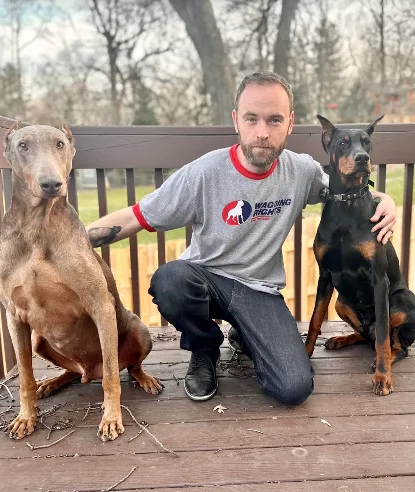
My name is Tim Rains and I am the owner and dog trainer of Wagging Rights dog training. I am proud to be serving the fox valley area. One of my biggest joys is helping people learn to communicate with their dogs and increase the bond between them.

Learn More About Me

Certified Dog Trainer

I specialize in puppy training, behavioral modification, obedience, reactivity, and off-leash reliability—helping families build calm, confident, and capable dogs they can trust anywhere.

Learn More About Me

Check Out Our Service Areas

About Our Dog Training

All of our trainers are certified dog trainers with many years of hands on experience. We continue our education each and every year by attending seminars, workshops, being members of professional dog training educational organizations, shadowing other reputable trainers, and by studying books as well as videos. 

By being a member of several professional dog training organizations, we have access to and learn from some of the absolute best and most respected trainers in the industry. Through these experiences, we grow our skills, learn from the best, and spends much-needed time training dogs. 

We understand that the reality of owning a dog, especially one with behavioral issues isn’t the same as the relationship you envisioned prior to getting a dog. It can be embarrassing, frustrating and down right dangerous. Our goal is to get you as close to your ideal relationship as possible. With the right knowledge, tools and hard work you will be amazed at what we can accomplish together.

Wagging Rights offers comprehensive private lessons rooted in rewards-based balanced training methods. Through our customized lessons, we provide effective training solutions that are proven to dramatically increase your dogs reliability, extinguish their problem behaviors, improve their quality of life and improve your relationship with your dog. Additionally, Wagging Rights ensures that you’re involved in every step, so you have the tools and knowledge you need to maintain what you’ve learned long after formal lessons have concluded.